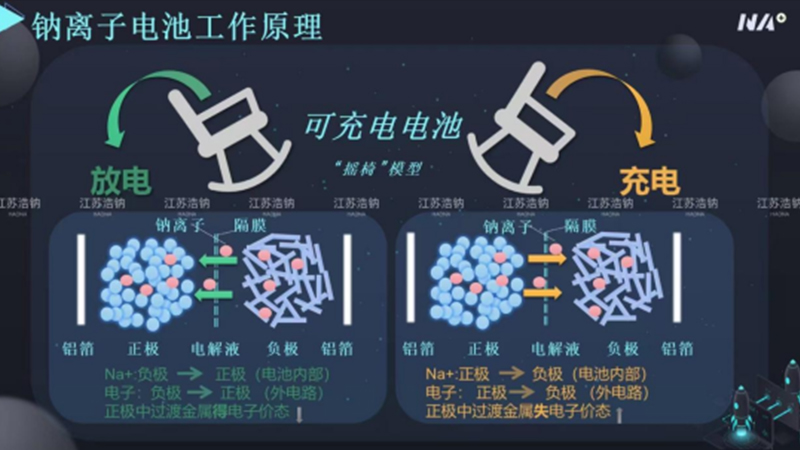
The electrolyte, as an important component of sodium-ion batteries, is not only the only medium for charge transfer between the positive and negative electrodes, but also determines the maximum reversible capacity that can be realized by the battery. Currently, the commercial sodium ion battery electrolyte has a single formulation, mainly using sodium hexafluorophosphate (NaPF6) as the main sodium salt (NaClO4 is less feasible for industrialization due to its explosive and strong oxidizing properties), and ester-based EC or PC as the main solvent, supplemented by 5% FEC as the electrode interfacial film-forming additive. Although it can basically meet the current needs of material characterization and device assembly, it still faces problems such as poor compatibility of positive and negative electrodes, narrow operating temperature range and slow ion transport kinetics, which can lead to a short cycle life of sodium-ion batteries and possibly a more serious gas production phenomenon. In order to improve the many problems faced by sodium-ion batteries, 江苏浩钠新能源科技有限公司 plans to carry out the following three aspects of technological research and development based on the modification and optimization of the electrode materials and starting from the electrolyte:
1. Development of sodium ion battery electrolyte with wide temperature range: through composition optimization and adjustment of solvation structure, the low-temperature ion transport kinetics and high-temperature thermal/chemical stability of sodium ion battery electrolyte can be improved, so as to broaden the working temperature range of sodium ion battery.
2. Develop new electrolyte additives for sodium ion batteries: through the development of new electrolyte additives, a CEI/SEI film with high ionic conductivity and stable structure is derived at the positive/negative electrode interface. The aim is to passivate the positive/negative interface, weaken the side reaction, inhibit the electrode gas production and the continuous decomposition of the electrolyte, and improve the cycling stability of the sodium ion battery.
3. Customized design of sodium ion battery electrolyte: Due to the unavoidable component interaction between electrolyte and electrode materials, theoretically, there is no specific electrolyte that can be universally applied to a variety of electrode materials. Therefore, according to the current situation of diversified positive/negative electrode materials for sodium ion batteries, it is planned to customize the optimal electrolyte formula for the company's electrode material products through the combination design of sodium salt, solvent and additives.